
Summary: Hospital supply chain resilience has become a critical priority for procurement directors following disruptions that exposed vulnerabilities in import-dependent sourcing strategies. Domestic nitrile glove manufacturing with vertical integration eliminates third-party dependencies that create supply interruptions during extreme weather events, geopolitical tensions, and public health emergencies. Healthcare facilities face mounting pressure to build procurement strategies that balance cost efficiency with supply security. Strategic partnerships with domestically integrated nitrile glove manufacturers provide the capacity, compliance documentation, and reliability assurance that large hospital systems require.
Understanding Supply Chain Vulnerabilities in Healthcare Procurement
Your hospital’s ability to deliver consistent patient care depends on uninterrupted access to essential medical supplies, such as nitrile gloves. Recent disruptions have demonstrated that hospital supply chain resilience cannot be taken for granted. When Hurricane Helene damaged Baxter’s production facility in North Carolina in September 2024, hospitals nationwide faced critical IV fluid shortages, forcing them to cancel surgeries and postpone procedures.
The challenge goes beyond responding to individual crises. Premier’s 2024 Supply Chain Resiliency Report found that 51.1% of suppliers faced geopolitical issues. Another 56.8% were affected by climate and severe weather events. Meanwhile, your hospital depends on supplies from complex international networks.
Domestic nitrile glove manufacturing eliminates overseas shipping, customs complications, and foreign dependencies. For large hospital systems, this means predictable supply planning and manufacturing that adjusts to both routine and emergency demands.
The Financial Impact of Supply Disruptions on Hospital Operations
Understanding the financial impact of supply chain disruptions requires looking past unit pricing for nitrile gloves. If contracted suppliers can’t deliver, cascading costs impact every aspect of hospital operations. Clinical staff lose confidence when nitrile glove products change frequently, requiring additional training. Your value analysis committees then demand justifications for supplier switches, which uses administrative resources.
Tariff-related expenses are expected to significantly raise hospital costs, and administrators may delay equipment upgrades to manage financial strain. These estimates exclude opportunity costs: postponed procedures, lower patient satisfaction, and staff morale affected by ongoing supply uncertainty.
Hospital supply chain resilience through vertical integration addresses these hidden costs by providing supply certainty for critical items like nitrile gloves. When a manufacturer controls every step from raw materials to finished product, you gain visibility into production capacity, inventory levels, and potential constraints before they become crises. For procurement directors managing budgets where expenses grow while Medicare reimbursement covers only 83 cents per dollar spent, eliminating supply chain volatility becomes a financial imperative.
Domestic Manufacturing Scale: Meeting Hospital Nitrile Glove Demand
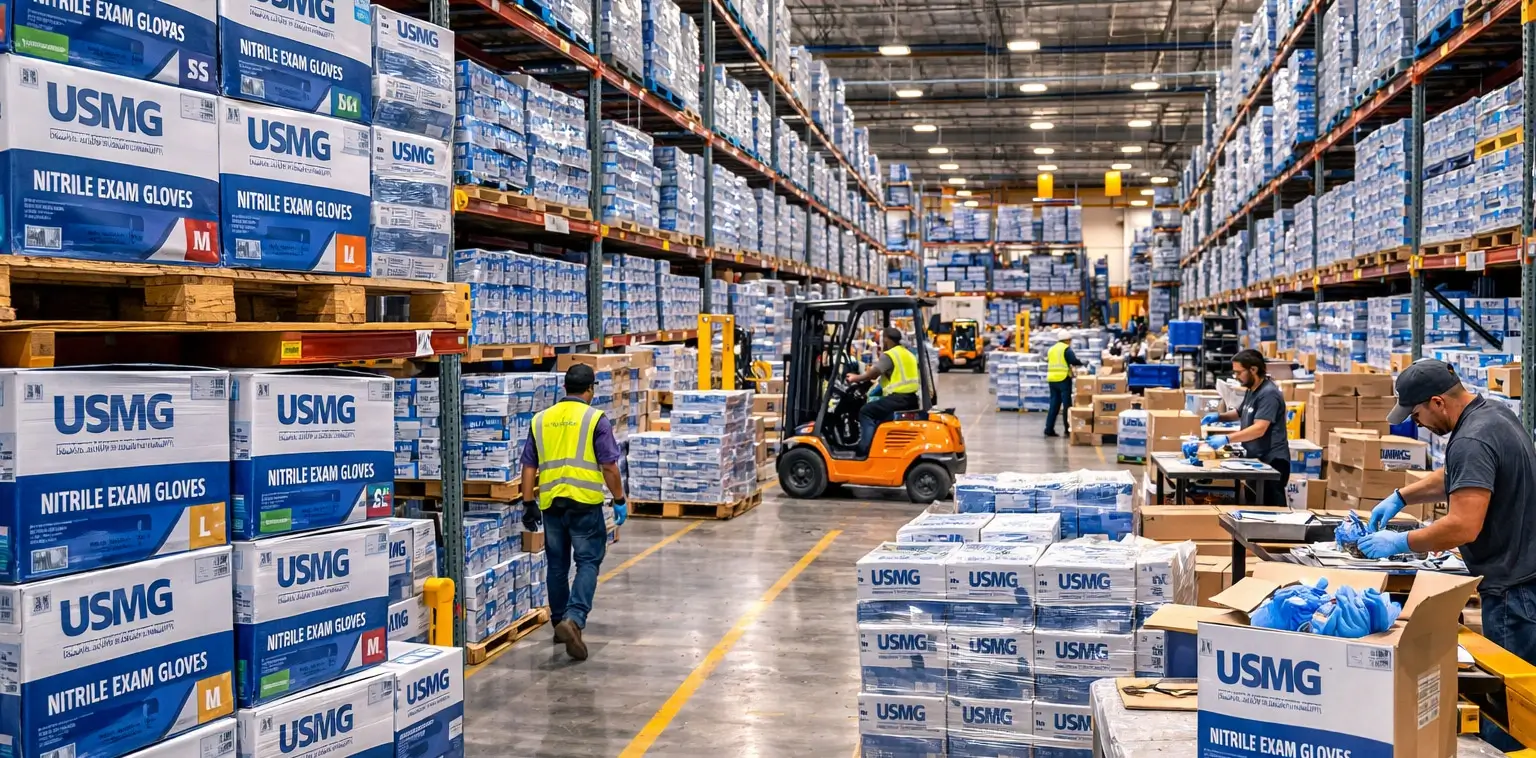
Can American nitrile glove manufacturers produce the volume your multi-facility health system requires? The answer depends on manufacturing scale: producers with seven million square feet of production space offer capacity that smaller operations cannot match.
Producing 2.5 billion nitrile gloves annually means a daily output of seven million, absorbing both routine and sudden surge orders without sacrificing quality or extending lead times. This scale provides immediate flexibility when your emergency department faces patient influx or seasonal surgical increases—avoiding the 8-12 week lead times common with overseas sources.
This capacity advantage is valuable for standardizing nitrile gloves across facilities. Consolidating with a single domestic manufacturer with proven capacity enables you to negotiate better prices. You ensure consistent quality everywhere. Clinical teams trust standardized gloves. Inventory management improves, and compliance documentation stays uniform.
Building hospital supply chain resilience requires reliable manufacturing partners. Domestic production avoids transport delays, natural disasters abroad, and raw-material shortages that heighten international supply chain risks.
FDA Compliance and Quality Assurance in Nitrile Glove Procurement
Your responsibility extends beyond ensuring nitrile gloves are available—you must ensure that every product meets rigorous safety and performance standards. FDA 501(k) clearance and ASTM compliance aren’t just regulatory checkboxes; they’re the foundation of patient safety and your professional liability protection.
Domestic nitrile glove manufacturing offers clear advantages for compliance verification. You can audit facilities without international travel issues, and request documentation, trusting that it reflects current practices. When questions arise about glove performance or safety, you engage directly with teams under FDA oversight and familiar U.S. regulatory frameworks.
Consolidating to domestic nitrile glove manufacturers with FDA 501(k) clearance and ASTM compliance simplifies quality assurance. It also strengthens your position in value analysis committee reviews.
Infection prevention teams and clinical department heads need assurance that nitrile gloves will perform consistently. When you provide detailed compliance documentation backed by domestic manufacturing and FDA inspection, you instill confidence. This supports smooth implementation. Your approach maintains supply chain resilience by ensuring steady quality, even under supply pressure.
Related: Why FDA Compliance Matters For Nitrile Gloves in Emergency Use
Sustainability Leadership Through Domestic Nitrile Glove Manufacturing
Healthcare organizations now face board-level mandates for environmental leadership. Nitrile glove procurement decisions impact more than cost and quality. They affect sustainability reporting, carbon footprint, and ESG performance metrics.
Domestic nitrile glove manufacturing with integrated sustainability practices offers a solution that addresses both requirements. Closed-loop water systems that recycle 100% of water used in production provide measurable resource conservation you can document in sustainability reports. When facilities operate their own power stations, they reduce grid dependency and demonstrate energy resilience that aligns with your hospital’s supply chain resilience goals.
Sourcing domestic nitrile gloves reduces the carbon footprint by eliminating overseas shipping and associated transportation impacts. These tangible metrics help procurement directors on sustainability committees show clear environmental progress without compromising clinical operations.
U.S. manufacturers optimize packaging for regional distribution, reducing material waste and disposal costs. This achieves measurable waste reduction as promised by your
Learn more about our use of water recycling technology.
Building Strategic Partnerships for Long-Term Supply Security
The old procurement model—selecting glove suppliers based mainly on unit pricing—no longer works. Your role has changed from purchasing agent to strategic risk manager, and your vendor relationships need to evolve accordingly.
Vertically integrated U.S. manufacturers offer partnership benefits beyond transactions. In a disruption, you need suppliers who prioritize your facilities and understand your coordination, committee needs, and budget constraints.
This partnership is most valuable during crises. In a pandemic, disaster, or geopolitical disruption, your place in the supply queue relies on relationship strength, not contracts alone. Even with seven million square feet of domestic nitrile glove production, manufacturers prioritize long-term, committed partners when meeting surge demand.
When you demonstrate to leadership that your procurement strategy has eliminated supply disruptions, reduced total cost of ownership, and advanced organizational sustainability goals, you position yourself as a strategic contributor. Hospital supply chain resilience built through domestic nitrile glove partnerships delivers measurable value that leadership recognizes and rewards.
Actionable Steps for Strengthening Your Nitrile Glove Supply Chain
Transitioning from import-dependent to domestically resilient nitrile glove supply chains requires systematic planning. Start by conducting a comprehensive vulnerability assessment of your current suppliers. Document where nitrile gloves originate, identify single-source dependencies, and calculate the true cost of supply disruptions.
Next, evaluate domestic nitrile glove manufacturing alternatives using criteria that extend beyond unit pricing. Request detailed capacity documentation that demonstrates the ability to meet your multi-facility demand during both routine and surge periods. Verify FDA 501(k) clearance and ASTM compliance through direct documentation review. Assess sustainability metrics, including water recycling, energy sources, and carbon footprint data, that you can incorporate into ESG reporting.
Engage your clinical stakeholders early in the evaluation process. Schedule nitrile glove product trials that allow nursing staff, surgical teams, and infection prevention specialists to assess performance under actual working conditions. Their input strengthens your value analysis committee presentations and reduces implementation resistance.
Develop a phased implementation timeline that allows a gradual transition rather than abrupt supplier changes. Start with high-volume, standardized nitrile glove products where supply reliability delivers immediate value, then expand to specialized items as relationships mature. This methodical approach to building hospital supply chain resilience demonstrates strategic thinking that leadership values.
Securing Your Hospital’s Future Through Domestic Manufacturing
The supply chain landscape you navigate will continue evolving. Extreme weather events will remain frequent. Geopolitical tensions will create ongoing uncertainty. Public health emergencies will test procurement strategies. Your success depends on building systems that perform reliably despite these persistent challenges.
Hospital supply chain resilience through domestic nitrile glove manufacturing isn’t about eliminating all risk—it’s about controlling the variables you can influence while reducing exposure to factors beyond your control. When you partner with vertically integrated manufacturers operating at scale within the United States, you gain supply certainty backed by capacity, compliance, and commitment to long-term relationships.
If your healthcare system is evaluating domestic supply chain strategies for critical nitrile glove procurement, our team brings expertise in helping procurement directors navigate the transition from import-dependent to vertically integrated sourcing. Contact Health & Hospitality Supply to discuss how our manufacturing capacity and compliance documentation can support your hospital supply chain resilience goals while meeting the budget expectations that leadership demands.